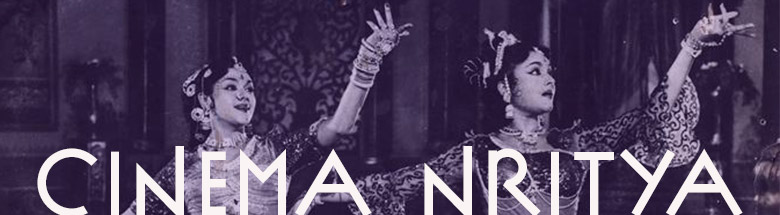

Midway through the film, Venkatasubbaiah is invited to witness the performance of a Tanjore dancer who has made the challenge that the kingdom has no dancers to equal her. She gives a beautiful Bharatanatyam performance and is then followed by a local dancer for whom Venkatasubbaiah lends his beautiful voice. The scene is shot at the lovely Chitradurga Fort.
The dance itself has no English subtitles unlike its speaking parts or the rest of the film which is most perplexing! In conversations with the ever-helpful blogger Ramesh, I learned that the Tanjore dancer is performing to lyrics from ashtapadis (stylized hymns) of the Gitagovinda. The Geeta Govinda (Song of the Cowherd) was composed by the 12th century courtly poet Jayadeva and is considered to be one of the finest examples of Sanskrit poetry. The work is a subject of much further discussion, but in sum it tells of the passionate love between Radha and the divine cowherd Krishna and echoes beliefs of the Bhakti movement in Hinduism.
Ramesh graciously offered to find and translate the Sanskrit lyrics into English which I have overlaid onto the video itself. Thank you Ramesh!! Sanskrit translations often are subject to debate, but I think the fairly literal translation here is priceless for non-Indians like me to understand the dancer’s expression and gestures. While I have always liked the scene for its aesthetic beauty, knowing the meaning behind the vocals has greatly enriched the viewing experience of one of the most pure and authentic classical dance numbers in Indian film. I am also mesmerized by the voice of the male singer accompanying the Kuchipudi dancer- what divine tone and ability! For your viewing pleasure…
With the translation displayed, it’s clear how the dancer’s abhinaya (mime) matches the poetic descriptions of things like honeybees, sandal paste applications, and yearning eyes. Lines are often repeated twice and the dancer usually performs the abhinaya slightly differently each time. I especially love the pure dance piece about halfway through. The second dancer, whom Ramesh tells me is dancing Kuchipudi, is clearly not as good as the first, though at the end she is awarded the post of “court dancer” by the king. Venkatasubbaiah is also awarded a gift and scholar-ship for his singing abilities which moves the story forward and ensures that the dance scene doesn’t seem out of place in the film.
Regarding the people who made this beautiful dance scene possible, the Tanjore dancer is enacted by Kalakshetra-graduate Jayalakshmi Eswar who still dances today and has authored some instructional classical dance DVDs. Choreography is credited to Radhakrishna and the famed guru Adyar K. Lakshman whom Padma Subrahmanyam called the “first freelance natuvanar [dance recital conductor and singer] in the field of Bharatanatyam.” He also is said to have taught at Kalakshetra and Vyjayanthimala Bali’s school Natyalaya. I also found another exquisite film dance of his that I will feature in an upcoming post about classical dances in Kannada films.
One thing I found especially interesting to learn was the deep effect the Geetagovinda has had on eastern India and Odissi dance. The Sri Geetagovinda Pratisthana trust explains (archived here), “Even today the influence of Geetagovinda is quite powerful on the culture of Orissa. Notably, Odissi dance, now enjoying great revival, derives many themes from Jayadeva’s songs and the famous Dasavataara song is a part of the repertoire of every Odissi dance.” This is clearly reflected on the website for Srjan, the gurukul-style Odissi dance repertory following the distinctive style of the late guru Kelucharan Mohapatra, which has DVDs of Kelucharan’s performances from the Geeta Govinda and some passage translations.
Reflecting upon the meaning of the Geeta Govinda, the trust notes, “What Krishna is enacting through this mystic love play is only to shower his Love and Grace on entire humanity.” I liked the way a reviewer of a paperback translation on Amazon put it (update: not locatable now), that it’s not mere erotic poetry but rather “is written for liberated souls to relish.” Relish, indeed!

minai, youre welcome.
ReplyDeleteThe only name you seem to have missed out in the artist credits is : the male singer is Dr M Balamurali Krishna someone who for long straddled the world of carnatic singing and films.
Wow!
ReplyDeleteI never expected to find a white girl interested in south indian movies to the extent of knowing Allu Arjun by name and movies...
Warms my heart.
satya
I don't think Minai knows Allu arjun by name I think she just calls him Bunny ;)
ReplyDeletelook at the big post she knows,.. btw love the bhukailas/bhukailasa post also
ReplyDeleteVery good blog!Many Congratulations.
ReplyDeleteIf you want to visit my blog, go here: http://cinema-indiano-bollywood.blogspot.com/
satyask - hi! Yes, us white girls can do surprising things! But if you really want to see a non-Indian who knows lots about Allu Arjun, I recommend you check out Nicki's blog: http://apunbindaas.blogspot.com/
ReplyDeleteJuze - Hello! Thank you for the compliment; will visit your blog. Cheers!
Minai,
ReplyDeletereally?! do tell.. :D
take a look,
ReplyDeletehttp://www.yourpublicmedia.org/content/cptv/tales-divinity-storytelling-through-classical-indian-dance
daria
daria - very interesting video art by a non-Indian who is interested in Indian classical dance. Looks like it was broadcast on Connecticut public television? The computer-aided imagery looks almost otherworldly, and I'm curious about why the sounds of the ghungroos are for the most part edited out. Thank you for sharing. :) It reminds me of another video I found randomly on YouTube, a sort of teaser for a feature on Bharatanatyam. Just look at how exquisite the dancer looks in slow motion: http://www.youtube.com/watch?v=jmqqeAdAyYs
ReplyDeleteOh yes, I saw it! But do you know where can we find the entire documentary?
ReplyDeleteMaybe it's still in editing... If you find it, post it!
daria
hi minai
ReplyDeletea little late to the party here. hamsa geethe made wonderful use of jayadeva's gita govinda...sung by the mesmerising balamuralikrishna. you can check out 2 pieces here:
http://www.youtube.com/watch?v=XSxgcwrylWw
http://www.youtube.com/watch?v=1G9nWpvK35E
if anyone's interested in delving into gita govinda, this is a good reference:
ReplyDeletehttp://www.giirvaani.net/giirvaani/gg_utf/gg_utf_intro.htm
hi cram - I meant to say thank you for the links above. That first Hamsa Geethe song is especially melodious- just beautiful.
ReplyDeleteThe singers featured in the entire scene are : M Balamuralikrishna, M L Vasanthakumari and B K Sumithra. This was MLV's last foray into film music. As is well known, MLV had quiet an impactful career in film music from 1950s - 70s. During this time she sang in Kannada, Telugu and Tamil films. Her only appearance in Hindi film is the thillana she sang for Raj Kapoor's film Chori Chori.
ReplyDeleteAnon - Thank you for the additional information.
DeleteAnother goodie that I missed. I liked the second dancer too, earthy and sweaty. Wonderful video. Will look for more videos from the film. Thanks.
ReplyDeleteThanks for your blog. Today I am attending a screening of the film hamsageethe at chennai tamilnadu, India as a guest with the art director of the film, p. Krishnamoorthir. I intend to share the information you have provided in your blog with the audience regarding the dance competion
ReplyDeleteI'm so happy to hear Hamsageethe is still getting screened, and your attendance with the film's art director is a treat! Thanks for letting me know my post was useful in adding material for your presentation.
DeleteNice to see a blog post on Hamsa Geethe. Though my knowledge about Carnatic music is limited, this movie is one of my favorites. It was 80s during my school days I saw Hamsa Geethe first time, the scenes & sounds of the movie captivated me... probably that's when my interest in forts got ignited. My search for the movie CD was a long one, almost a decade. A week back I found the movie and also the novel at Total Kannada :) and got them. Finished watching the movie few minutes back. I'm sure I'll watch it many times again..
ReplyDeleteAnother movie which had a lasting effect, which fueled my passion for forts is Bara, shot at Bidar fort. Incidentally, lead roles of both movies are portrayed by Anant Nag.
Hello siddeshwar - I'm happy to hear you connected with something you've been searching for for a long time. Oh how I know that wonderful feeling! Bara seems like another movie that is difficult to get a hold of. :)
DeleteThe story was *NOT* based on a real person - Bhairavi Venkatasubbaiah was a character imagined by Ta Ra Su.
ReplyDeleteThanks for the info--I've not researched the issue further, hence my "supposed" word choice in the first paragraph.
DeleteThanks for this post! - jay
ReplyDelete